Havering’s Council Meeting, 3rd September 2025

Question Time (QT)1

The 2026 election is fast approaching. QT is designed for councillors to strut their stuff prior to the election. Penetrating questions are asked to embarrass the Administration and make colleagues cheer. There’s a flurry of newsletters, Havering Daily articles and an inner-glow after flaunting their excellence for constituents.

So how did they do?

Two types of questions. The dedicated ward councillor working hard highlighting failures of the Administration. The second type relates to scrutiny of performance. At this meeting the balance was 50:50.

Local Issues

Jane Keane (23 minutes and 33)2 asked questions on fly-tipping and air pollution from idling cars. Barry Mugglestone disliked the idea of a ‘Wall of Shame’ for fly-tippers. He was cornered because of its novelty and wasn’t sure how popular it might be. Philip Ruck (17) didn’t appreciate only the police could enforce the 20 mph zones. Darren Wise (26) was brushed off about recycling bags. Robert Benham (45) was also brushed off by Barry, who had returned to form.

Policy Issues

Questions about policy are embarrassing for HRA because cabinet members are weak. Graham Williamson didn’t know social and affordable housing are different categories in his answer to David Taylor’s (27) question. Likewise, Chris Wilkins. He floundered answering a penetrating question from Martin Goode (15). The question related to LBH’s bankruptcy and his lack of understanding made me flinch.

Paul McGeary plumbed the depths of ignorance. He said *ILLEGAL* HMOs3 weren’t shut down because they added to the homeless figures. Housing can be completely illegal and it doesn’t matter as long as tenants don’t turn up on the council’s doorstep. This was an *answer* to Tim Ryan’s (30) brilliant question. Is it the case that Havering ratifies *ILLEGAL* HMOs to massage the housing figures? Is this policy?

Conclusion

QTs was good for the Opposition parties but will they build on their successes? Probably not.

Notes

1 (Public Pack)Agenda Document for Council, 03/09/2025 19:30 The QT questions The webcast is at Annotator Player

2 Times refer to the webcast

3 HMO = houses of multiple occupation
Havering Council Meeting, 23rd July 2025 (Part One)

Councillors quiz cabinet members at Question Time (QT)1. Environmental questions dominated, with 8 out of 15. Two critical issues weren’t asked: (1) Green Belt development, and (2) Air pollution.2 There was however, a motion about the Launders Lane disaster.3

QT is critical and only 35 minutes were used of the 45 available. This suggests that the 15 questions limit should be scrapped. QT should end when the 45 minutes are complete. This would bring it into line with Parliament’s PMQ.4

Discussion

Barry Mugglestone’s interesting style buries questions in a blizzard of legislation references. For supplementary questions he says either councillors or members of the public haven’t kept him informed, so it’s their fault there’s a problem. David Taylor’s question about tree feathering narrowing the pavement outside Mawney school (Q10, 43minutes) was a classic example. He said he’d prioritise this in 2026. Result!

Philip Ruck (31) asked about cabinet members avoiding scrutiny committees. Ray Morgon conceded the point and, in effect, said they’d been ordered to attend. Based on answers by Chris Wilkins (35 and 45), Graham Williamson (53) and Natasha Summers (26) attendance might not mean enlightenment.

Finally, Viddy Persaud (39) raised the important question of the premature collection of Council Tax. Ray Morgon conceded this administrative error, apologised and moved on. It is impossible to avoid the thought that some people might have been thrust into a temporary overdraft. This is costly. Viddy didn’t pursue that point.

Best Question: Philip Ruck

Notes

1 Council Questions 23 July 2025.pdf All times come from this webcast Annotator Player

2 Gallows Corner is shut and perfect for a *Before-After* analysis.

3 Motion C proposed a debate about this issue. Motions.pdf Surprisingly it didn’t demand the reinstatement of the Statutory Nuisance Notice.

4 The weekly Prime Ministers Questions

Havering’s Overview and Scrutiny Board, 3rd July 2025

Introduction

Item 6, concerned sick leave, agency staff and its financial implications.1 Sick leave levels, [Have] fallen further to 9.9 days at 30th April 2025.” Appendix 2says this amounts to 20,807 days per year. National statistics say, “There was also a fall in days lost per worker, to 4.4 in 2024…”2 Havering’s council is 125% above the national average at a cost of £2m p.a.

Stress, depression and mental health costs the council £610K and Muscular-skeletal costs £506K, both annually.3 These are the two biggest categories.

Councillors are a poor example for staff.4 In the six months to 5th July 2025, 55 councillors were scheduled to attend a total of 460 meetings. They attended 386 – a 16% absentee rate.

The council is rotting from the head down.5

Discussion

There were important contributions from David Taylor (1:55).6 He said that agency staff were healthier. At (2: 04) he said ‘Millennials’ were very sickly. His best point was (2:19) when he posited causes of muscular-skeletal sick leave (£506K). He suggested one cause might be ‘Working from home’ with poor working conditions. Jane Keane pondered ‘tolerated’ sick leave as a reason for sick leave. She then discussed domestic abuse and sick leave. Other contributions were made by Matt Stanton, Dilip Patel and Martin Goode.

Officers made few substantive replies to councillors with too many ‘getting back’ with emails later.

Conclusion

The committee is a joke. There was 41% councillor absenteeism at this meeting. This ruins institutional memory. The contribution of Phillippa Crowder (2:29) demonstrated the power of that memory. It also destroys any development of forensic debating skills. Scrutiny should be uncompromising but this committee is cosy and nice.

Innovative strategies for bringing Havering’s statistics in line with national levels don’t exist.7 Questions about dismissals for poor staff attendance weren’t asked. Likewise, challenging failed strategies was obviously infra dig.

Councillors are complicit in accepting Havering’s sick leave culture.

Notes

1 HR 1 – Report.pdf

2 HR 2 – Appendix 1 and 2 OS Report – Data Dashboard.pdf See also Sickness absence in the UK labour market – Office for National Statistics Havering is trying to achieve 8 days of sick leave, which is, apparently a stretch target.

3 loc.cit Appendix 2b

4 Havering Councillors’ Attendance: 1st August 2023 – 24th January 2024 – Politics in Havering

5 Absentees: cllrs Ruck (he was present via Zoom which counts as an absence), Garrard, Godwin, Vincent and Anderson:  5 out of 12 (41%)

6 Annotator Player Timings refer to this webcast

7 Worse than that: the target set is 8 days sick leave, 3.6 days above the national level.

Havering’s Secondary Academies: Their Progress 8 Rankings, 2024

The government’s performance analysis1 creates a ‘level playing field’ for comparisons. The government’s Progress 8score is their tool of analysis. This is,

“The academic progress that pupils make from the end of key stage 2 to the end of key stage 4. This is based on 8 qualifications.”

Progress 8 predicts GCSE results based on a statistical analysis of KS2. KS2 results are an effective tool, which generates GCSE profiles for a school’s intake. The government uses five categories -Well Above Average, Above Average, Average, Below Average and Well Below Average.

A high Progress 8 score isn’t correlated with GCSE results. It is based on ‘Added Value’ that a school gives to their students. For example, Sacred Heart of Mary has a higher ranking than Coopers Coburn despite their GCSE results being similar. The higher ranking of Sacred Heart is because their 2019 intake had lower KS2 outcomes than Coopers. This implies Sacred Heart add more ‘value’ than Coopers.

Progress 8 doesn’t predict what any particular student will do. Students in every category of school will under, or over, achieve. Progress 8 is a statement about a school’s performance in general.

Well Above Average2

Sacred Heart of Mary, Campion and Harris Academy Rainham

Above Average

Royal Liberty, Coopers Coburn, Frances Bardsley, Hall Mead, Redden Court and Hornchurch High

Average

Gaynes, St Edward’s and Drapers’

Below Average

Abbs Cross, Emerson Park, Marshalls Park, Brittons and Sanders Draper

Well Below Average

Bower Park

Notes

  1. Search results for “Havering” – Compare school and college performance data in England – GOV.UK
  2. This list is in ranking order. Therefore, Sacred Heart is the highest-ranking school in the category ‘Well Above Average’. Likewise Royal Liberty, Gaynes and Abbs Cross in their categories

Why isn’t there a Standard Format for the publication of GCSE results?

Havering doesn’t have a standard format for publishing GCSE results.1 As a result they’re difficult to interpret. Havering’s schools aren’t alone;

Woodford County High, Redbridge2

No of Year 11 pupils 178
No of GCSE entries 1754
% of levels 9 – 7 (equivalent to A*+ A Grades ) 80%
% of levels 9 32%
% of pupils achieving 5+ levels 9-5 100%
% of pupils achieving 5+A*-C levels 9-5 including English & Maths 99%
% of students attaining English Baccalaureate 97%

There’s little detail – does the school have any weak subject areas? – but what is published is intelligible.

Hornchurch High School3

This school offers time-lapsed results from 2022, even though the 2023 results came out in late August ’23.

Performance Measure
Progress 8 Score -0.42
Attainment 8 Score 45.4
% pupils achieving a grade 5 or above in GCSE English and maths 40
% pupils entering the English Baccalaureate (EBacc) 72
English Baccalaureate Average Points Score 4.22
% of pupils staying in education or employment after KS4 88

Who this set of statistics is for is unclear. Current information can be found on the government website4 – which the school identifies. That website is full of statistical detail, which might not suit everyone.

Abbs Cross Academy5
They offer 2023 results without mentioning subject areas beyond an English and Maths analysis. They offer a link to the government’s website for a league table.6 (They are average.)

Sacred Heart of Mary
Meanwhile Havering’s top performing school,7 shows what should done and provides a template for every school in Havering. Every subject is listed with the outcomes and the number of pupils who sat each examination.

Conclusion

There’s no acceptable explanation why Havering’s schools conceal examination results from parents and taxpayers. Last year this blog wrote about the same issue and ONE school immediately took action. Schools should understand that the publication of results is in their interests. This is especially the case in an era of conspiracy theorists.

Notes

1 How Havering’s Academies Conceal their 2022 GCSE Results – Politics in Havering

2 Woodford County High School For Girls – 2023 Exam Results

3 Hornchurch High School » EXAMINATION PERFORMANCE, 2021-22

4 Secondary – Hornchurch High School – Compare school and college performance data in England – GOV.UK (compare-school-performance.service.gov.uk)

5 Achievement And Performance – Abbs Cross Academy The school’s analysis of English and Maths is very technical and beyond most non-educator’s understanding. Effectively it’s meaningless for most parents.

6 All schools and colleges in Havering – Compare school and college performance data in England – GOV.UK (compare-school-performance.service.gov.uk)

7 GCSE-RESULTS-SUMMER-2023-v3.pdf (realsmart.co.uk)

Havering Council Meeting, 18th January 2023

Damian ‘Mick Lynch’ White has led the Romford Conservatives out on strike. The ‘Winter of Discontent’ suits his mood.1 He doesn’t like his loss of allowances and powerlessness. This council meeting, for the first time ever, had no opposition motions. The Mayor was so pleased he nearly did a jig at the end of the meeting.

The Conservatives used Question Time instead of motions.2 As is traditional, only innocuous questions are asked. Question One by David Taylor concerned Romford FC. This has appeared every four years since the 1990s and isn’t a Number One question. Subsequently David tried a knockabout on London Mayor Sadiq Khan’s consultation methods but he doesn’t know how to land a glove. (We all missed Keith Prince’s ranting passion.)

Question Four about bin collection was pure Martin Goode gold. Barry Mugglestone was brusque. He pointed out Havering doesn’t revolve round Harold Wood. Question Five from Viddy Persaud became a trick question when Barry explained the difference between standing water and floods. She isn’t quick on her feet and floundered. Question 14 on homelessness was complex. Neither the question nor answer were understandable but Joshua Chapman and Paul McGeary seemed happy: so that’s alright then!

But were Havering’s taxpayers served well? Not at all. It was disgraceful.

Notes

1 Annotator Player (sonicfoundry.com) You can watch the meeting here

2 Council Questions 18th January 2023.pdf (havering.gov.uk) All 14 questions are here

Havering’s Timid Councillors

Councillors should make their home address publicly available on the Register of Interests.1 Get-out clauses to this are laid out in government advice (see Addendum). Many of Havering’s councillors don’t make their addresses public and six haven’t made a meaningful response. The six might not live in the borough, who knows? 27 councillors concealed their addresses. Why?

Some councillors are fearful “because they believe the process [making addresses available] risks their safety or makes them vulnerable to abusive activity.” Can this be true? Sadiq Khan, London’s Mayor, is subject to intense media attention, which often provokes threats to his safety. His Register of Interests statement deletes his home address, which is understandable. But a Havering councillor?

The fear argument falls immediately for councillors who share wards with co-councillors who do provide home addresses. Veteran councillors, from the 1990s, will remember that addresses and home phone numbers2 were published. Tiresome calls happened but not enough to claim that ‘violence or intimidation’ might ensue.

The notion that addresses are ‘private’ or can be ‘concealed’ is naive. Life in 2022 means living in the Surveillance Society. A malicious person can find an address easily on the internet. Do we want Havering’s councillors to be timid and naïve?

Addendum: Government advice to councillors on publicising their address

The Government wishes to avoid capable individuals being deterred from standing for office because they believe the process risks their safety or makes them vulnerable to abusive activity….The changes made mean that now all candidates in local government elections in England will be able to request that their home address is not made public. Candidates will have a choice – they can continue to include a home address if they wish to highlight their local connection to their ward. (my emphasis)

Source Letter to local authorities about the publication of councillors’ and candidates’ home addresses: March 2019 (publishing.service.gov.uk)

This builds on the Localism Act which spoke of ‘violence or intimidation’ as the principal criteria for concealing addresses. Localism Act 2011 (legislation.gov.uk)

Notes

1 Research done on 24th July, 2022 using Havering’s Register of Interests. This one is for Robert Benham. He wasn’t ‘chosen’ he’s the first councillor on the list mgConvert2PDF.aspx (havering.gov.uk) For Sadiq Khan see Sadiq Khan – Register of interests | London City Hall

2 Veteran councillors from the 1990s are Brian Eagling, Linda Hawthorn, Keith Prince, Michael White and Reg Whitney. This was prior to mobile phones

Havering’s Elections and the Budget, 2022-23

In the good-old-days voters knew where they stood. Conservatives were heartless; Labour were warm-hearted; Resident Associations (RA) loved pavements. Happy days!

Rishi Sunak’s Stately Home in Yorkshire: Council Tax Band H

Rishi Sunak, the Chancellor, set Havering’s Council Tax at 3%. He imposed the principal budget item, Adult Social Care, without funding it. This budget is demand led so no-one knows how much it will eventually cost. Councillors do know Havering has the oldest population in London and dozens of Care Homes. Central government has imposed Stealth Taxes on Havering for 12 years.

A £150 million budget1 was nodded through with passionate debate about £70,000 ‘savings’ from Councillors Allowances. This would be allocated to street cleaning. An RA policy!

The 3% Council Tax increase is inadequate. Inflation is 7% rising to 10% by December. The in-coming Administration will have to make some grim decisions in October.

Council officers wrote an analysis of ‘risk’ factors for the budget.2 Item C4 refers to business rates losses, “it is hoped that the Government will fully recognise this in future settlements”.  Interest rates have increased twice in three months. C8 says, “An increase in interest rates will have a direct impact on the Council’s treasury strategy.”  Each 1% increase equals £1 million of additional expenditure. C19 notes a potential loss of “several million pounds” and C22 says government alteration in charging for ‘Green Waste’ will cost £800,000.

The Administration’s 400 job losses will save £7 million.3 They are, “Staffing Reductions Through Efficiency”.  Achieved by removing, “activities that do not benefit residents.” Technology [has] “moved on significantly… [and] efficiencies through modernising work processes and improving service offers to our customers and partners.” A budget based on a ‘wish and prayer’.

Jeff Tucker declared he hadn’t read the budget before speaking for 25 minutes. But it was Rishi Sunak’s Stealth Taxes which needed discussing and he wasn’t present.4 So perhaps Jeff got it right.

Notes

1 Issue – items at meetings – 2022/23 Budget and 2022-2026 Medium Term Financial Strategy | The London Borough Of Havering

2 Microsoft Word – Appendix D – Risk Register (003) (havering.gov.uk)

3 Appendix A Budget Savings.pdf (havering.gov.uk)

4 Havering Council Tax Meeting, 2nd March 2022 – Politics in Havering

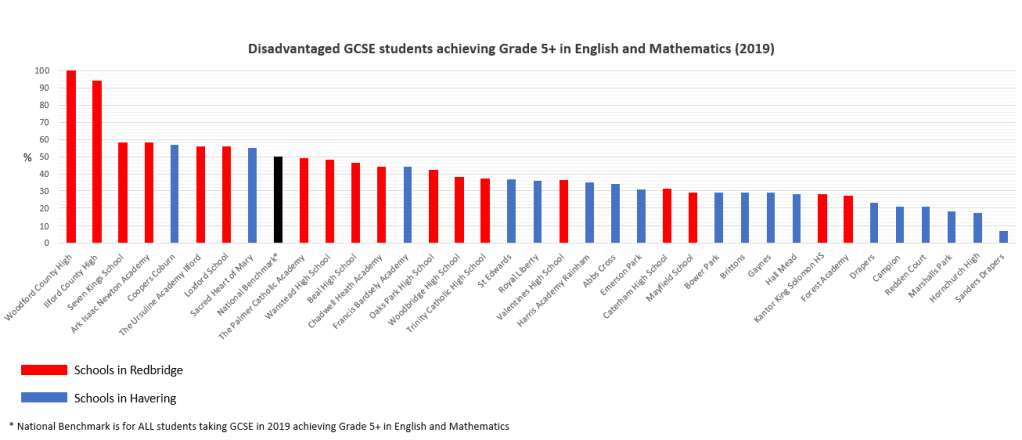
Havering and Redbridge’s Disadvantaged Secondary Students

‘Closing the attainment gap between disadvantaged children and their peers is the greatest challenge facing English schools. The gap is stubborn because its causes are entrenched and complex, and most lie beyond the control of schools and educators. However, it is clear that schools can make a difference.1

Havering and Redbridge have 18 secondary schools each. Redbridge’s disadvantaged students do markedly better than those in Havering (see Addendum).

Schools receive additional funding through the Pupil Premium (PP) to try to alleviate the challenges disadvantaged students face. PP funding is a flat rate for eligible students.

Marshalls Park, Havering, PP £232,245

The most recent examination results were published in 2019. The academy said their students achieved “…amazing results, some of the best the school has ever had.”    Their disadvantaged students achieved a catastrophic success rate of 18% at GCSE grade 5+ English and Mathematics.

Chadwell Heath, Redbridge, PP £241,230

They said, “This year [2019] our pupils have produced our best ever set of examination results.” Their disadvantaged students achieved 44% grade 5+ English and Mathematics. Chadwell Heath really has ‘Levelled-up’ giving their students a platform for ‘A’ levels post-16.

Discussion

The introductory quote neatly summarises the challenges presented by disadvantaged students. Marshalls Park focuses on, “The [attainment] gap is stubborn because its causes are entrenched and complex, and most lie beyond the control of schools and educators.”  In brief, school leaders work on the theory that the attainment gap is intractable, whereas Chadwell Heath has taken heart from, “However, it is clear that schools can make a difference,” and plan accordingly.

These two sentences sum up senior management responses. Schools which undervalue disadvantaged students hamper their achievement. This is revealed in the GCSE results for the two schools. Disadvantaged students are challenging but PP funding aids skillful management offering an empathetic response. It’s clear that schools that meet the challenge are rewarded with higher achievement for every student.4

Addendum


Notes

1 PP-Strategy-and-Costs-Reviewed-2020-21.odt (live.com)

2 Exam Results | Marshalls Park Academy  Marshalls Park Academy  for government statistics see- GOV.UK – Find and compare schools in England (compare-school-performance.service.gov.uk) For a general look at the way that Havering schools are mediocre see Havering’s Academy Schools: Councillor Robert Benham’s Dilemma – Politics in Havering

3 Chadwell Heath Academy – Exam results (chadwellacademy.org.uk)

4 Chadwell Heath’s students at grade 5+ English and Mathematics achieved 61%: Marshalls Park 46%.

South Hornchurch Ward: Utter Chaos

South Hornchurch is Havering’s political disaster zone. It’s a Residents’ Association (RA) stronghold which has imploded.

Michael Deon Burton fell out with the RAs and was re-elected as an Independent. 48 hours after being elected he became a Conservative. As Conservatives are toxic in South Hornchurch this was Damian White’s only route into the ward. Michael is an important part of Damian’s coalition. Damian’s Conservatives failed to get a majority and he had to win over those who were susceptible to his charms.

The re-drawing of Havering’s ward boundaries reduced South Hornchurch to two seats from three. Easy-peasy you might think. As there are only two RA councillors left, they carry on. Unfortunately life since 2018 has been unkind. Michael is awaiting trial for harassing RA Natasha Summers1,2 and as a renegade he’s unlikely to be elected. She hasn’t enjoyed being a councillor and might not stand.

The elderly, but feisty, Graham Williamson3 is the last RA standing. The self-inflicted damage the RAs have suffered will help Labour’s Julia Offord Pearman and Adeel Akhtar. Unlike Graham they live in the ward. Ironically this used to be the RAs selling point. Labour is campaigning. This is a skill complacent RAs forgot long ago. Campaigning can make a difference even in safe seats.

2022 is throwing up interesting contests but, as always, democracy is about who turns up to vote.

Notes

1 Havering Council Conservative denies harassment at court | Romford Recorder

2 See my blog Havering Councillor: Natasha Summers (South Hornchurch) – Politics in Havering

3 Graham features in Wikipedia Graham Williamson – Wikipedia