Havering’s Secondary Schools: Two Government Assessments

Havering’s schools have two forms of government assessment. Firstly, Progress 8 predicts GCSE results by using a statistical analysis of KS2. Schools which add value  means children will out-perform their expected grades. Secondly, OFSTED reports. They happen at multi-year intervals. Inspectors grade schools using five headings, (1) Overall effectiveness, (2) Effectiveness of leadership and management, (3) Quality of teaching, learning and assessment, (4) Personal development, behaviour and welfare and (5) Outcomes for pupils.

Progress 8

Well Above Average1

Sacred Heart of Mary, Campion and Harris Academy Rainham

Above Average

Royal Liberty, Coopers Coborn, Frances Bardsley, Hall Mead, Redden Court and Hornchurch High

Average

Gaynes, St Edward’s and Drapers’

Below Average

Abbs Cross, Emerson Park, Marshalls Park, Brittons and Sanders Draper

Well Below Average

Bower Park

OFSTED

OFSTED uses four summary categories Outstanding, Good, Requires Improvement and Inadequate. Reports aren’t annual and not necessarily current.

Outstanding

Hall Mead, Redden Court, Sacred Heart of Mary, Francis Bardsley (3 categories out of 5), and Royal Liberty (short inspection)

Good

Every other school.

Discussion

There’s no correlation between the two government assessments.

OFSTED criteria, Quality of teaching, learning and assessment and Outcomes for pupils are critical for every stakeholder using the reports.

How can a 22% GCSE Grade 5+ English and Maths pass rate for disadvantaged children at Abbs Cross2 be rewarded by a ‘Good’ assessment. OFSTED say, Trustees, leaders and staff have high expectations for all pupils, including those with special educational needs and/or disabilities (SEND). (my emphasis). ‘High expectations’ in this context is overblown.

Likewise, Marshalls Park. 42.1% non-disadvantaged children passed Grade 5+ English and Maths and are rated ‘Good’. This result is 5% below the national average and 10% below the Havering comparator. Worse: disadvantaged children achieved a sickening 21.8%4 English and Maths Gold Standard pass rate at Marshalls Park.

OFSTED reports aren’t fit for purpose. Their reports lack rigour and ignore outcomes which are important to society. Progress 8 focuses on added value, whichschools create. OFSTED ignores these insights. This is a criminal dereliction of duty.

Notes

1 Search results for “Havering” – Compare school and college performance data in England – GOV.UK See also Havering’s Secondary Academies: Their Progress 8 Rankings, 2024 – Politics in Havering

2 Abbs Cross Academy and Arts College – Compare school and college performance data in England – GOV.UK Grade 5+ English and Maths is a Gold Standard acting as an entry point for many post 16 opportunities

3 Abbs Cross Academy and Arts College – Open – Find an Inspection Report – Ofsted
4 Results by pupil characteristics – Marshalls Park Academy – Compare school and college performance data in England – GOV.UK

Havering’s Secondary Academies: Their Progress 8 Rankings, 2024

The government’s performance analysis1 creates a ‘level playing field’ for comparisons. The government’s Progress 8score is their tool of analysis. This is,

“The academic progress that pupils make from the end of key stage 2 to the end of key stage 4. This is based on 8 qualifications.”

Progress 8 predicts GCSE results based on a statistical analysis of KS2. KS2 results are an effective tool, which generates GCSE profiles for a school’s intake. The government uses five categories -Well Above Average, Above Average, Average, Below Average and Well Below Average.

A high Progress 8 score isn’t correlated with GCSE results. It is based on ‘Added Value’ that a school gives to their students. For example, Sacred Heart of Mary has a higher ranking than Coopers Coburn despite their GCSE results being similar. The higher ranking of Sacred Heart is because their 2019 intake had lower KS2 outcomes than Coopers. This implies Sacred Heart add more ‘value’ than Coopers.

Progress 8 doesn’t predict what any particular student will do. Students in every category of school will under, or over, achieve. Progress 8 is a statement about a school’s performance in general.

Well Above Average2

Sacred Heart of Mary, Campion and Harris Academy Rainham

Above Average

Royal Liberty, Coopers Coburn, Frances Bardsley, Hall Mead, Redden Court and Hornchurch High

Average

Gaynes, St Edward’s and Drapers’

Below Average

Abbs Cross, Emerson Park, Marshalls Park, Brittons and Sanders Draper

Well Below Average

Bower Park

Notes

  1. Search results for “Havering” – Compare school and college performance data in England – GOV.UK
  2. This list is in ranking order. Therefore, Sacred Heart is the highest-ranking school in the category ‘Well Above Average’. Likewise Royal Liberty, Gaynes and Abbs Cross in their categories

Havering’s Academies On Parade: Choose Me!

In the 1950s children attended their nearest secondary school and four years later they left. They started work the following Monday. And that was that.

It’s more complex nowadays. Schools are expected to be attractive and parents must choose a school. How? Choosing implies knowledge. Diligent parents do research, read OFSTED reports, scrutinise school’s web pages and attend Open Evenings.

Good GCSE results are a selling point for some parents. But what if the school isn’t a stellar performer? What happens then?

They shamelessly duck and dive.

St. Edwards Academy have an out-of-date ‘Performance and Results’ page. This is supported by the government performance website, which tells the reader that the school’s grade is ‘Well above average’.2 Expertise is needed to understand the website. The 2022 OFSTED report, which is readable, is good.3

Meanwhile Marshalls Park Academy is, “…incredibly proud of all students….and our 2024 results include many notable success stories.”3 They follow up with a link to the government website.4 Its banding is, “Well Below Average”.5 Nonetheless the school reaches the national ‘Gold Standard’ GCSE English and Maths grade 5.6

Coopers Coburn,8 Drapers Academy9 and Harris Academy Rainham10 publish exam results in full. Parents, who care about GCSE results, know exactly where they stand. There’s no ambiguity.

GCSE results aren’t commercial secrets, which need protecting. They’re part of the way in which parents chose a school for their child.

Addendum: Research note

This was written on the 27th October 2024. The schools quoted are a sample of the 18 academies in Havering. This topic is discussed in more detail here.11

Notes

1 Performance & Results | St Edward’s Church of England Academy

2 St Edward’s Church of England Academy – Compare school and college performance data in England – GOV.UK A dedicated parent would look at this table Download data – Compare school and college performance data in England – GOV.UK

3 St Edward’s Church of England Academy – Open – Find an Inspection Report – Ofsted

4 Marshalls Park Academy – Exam Results It continues, “Our two top performing students were Ralph Gilroy and Caoimhe Juson, with an impressive 16 grade 8 and 9’s between them.” The misplaced apostrophe is unfortunate in this context

5 Marshalls Park Academy – Compare school and college performance data in England – GOV.UK

6 loc.cit. This relates to 2023. It’s included because the school directed the reader to it.

7 loc.cit.

8 GCSE-Examination-Results-2024.pdf

9 Headline-Results-2024-main.pdf

10 Examinations Results – Harris Academy Rainham

11 How Havering’s Academies Conceal their 2022 GCSE Results – Politics in Havering NB Harris Academy have changed their presentation of results since 2022 and are now an example of best practice.

Havering and the Loxford School Trust

Abbs Cross and Gaynes Academies are owned by Loxford Schools Trust, Ilford. Loxford school is ‘outstanding’. Their Leadership Team believe they can transfer their successful formula. They now own five secondary academies.1

Academies are government funded businesses with Loxford receiving £50m.2 The twelve person leadership team, earn between £100,000 and £250,000. (Their CEO earns £54,000 more than Havering’s chief executive.) Stellar salaries demand consistent stellar performance. Their principal challenge is under-achievement of Disadvantaged Students.3

The Gold Standard: Grade 5 GCSE in English and Mathematics

The national outcome for disadvantaged students is 25.2% Gold Standard successes. For non-disadvantaged students the national outcome is 45.2%. This huge gap must be bridged to be rated excellent. Loxford School is excellent. Their disadvantaged students achieved 56% for the Gold Standard. Loxford’s disadvantaged students beat the national outcome in both categories. An outstanding performance.

It’s a different story in Havering.

Abbs Cross Academy: 23% of their disadvantaged students achieved the Gold Standard.4

Gaynes Academy: 33% of their disadvantaged students achieved the Gold Standard.5

Neither come close to Loxford’s result. Nor do they come close to the national 45.2% for non-disadvantaged students. Loxford’s Havering schools haven’t closed the Attainment Gap.

Havering, in general, has significant problems with under-achievement by disadvantaged students. Only four schools out of 18 reach 45.2% with their disadvantaged students. Loxford massively exceeded the national outcome with their disadvantaged students.

Conclusion

Loxford Schools Trust have failed. Four of their six secondary academies are below the all-student Gold Standard. Tabor Academy is catastrophically below that standard. They should be humble and recognise their stunning success in inner-city Ilford hasn’t travelled well.

Addendum: Loxford’s other academies and their Gold Standard outcomes

Warren Academy

49% for disadvantaged students, which is above the national outcome for all students. Barking and Dagenham’s non-disadvantaged students achieved 54%. 6

Tabor Academy

15% for disadvantaged students. This is catastrophic and demands action from the *stellar* Leadership Team in Ilford. Essex’s non-disadvantaged students achieved 49%. 7

Cecil Jones Academy

25% for disadvantaged students, which is the national average. Southend’s non-disadvantaged students achieved a stunning 66%. 8

Notes

1 Governance Profiles – Loxford School Trust

2 LOXFORD 2023ACCSWIZ.cvw (loxfordtrust.s3.amazonaws.com)  see p71

3 Key stage 4 performance, Academic year 2022/23 – Explore education statistics – GOV.UK (explore-education-statistics.service.gov.uk) Table 8 is an excellent summary

4 Results by pupil characteristics – Abbs Cross Academy and Arts College – Compare school and college performance data in England – GOV.UK (compare-school-performance.service.gov.uk) See also Havering’s GCSE Attainment Gap, 2023 – Politics in Havering

5 Results by pupil characteristics – Gaynes School – Compare school and college performance data in England – GOV.UK (compare-school-performance.service.gov.uk)

6 Results by pupil characteristics – The Warren School – Compare school and college performance data in England – GOV.UK (compare-school-performance.service.gov.uk)

7 Results by pupil characteristics – Tabor Academy – Compare school and college performance data in England – GOV.UK (compare-school-performance.service.gov.uk)

8 Results by pupil characteristics – Cecil Jones Academy – Compare school and college performance data in England – GOV.UK (compare-school-performance.service.gov.uk)

Havering’s People Overview and Scrutiny Committee, 5th March, 2024 (part two)

This agenda included a Housing item and the School Performance analysis. The latter is the focus of this blog.

Matt Stanton (1 hour47)1 expressed concerns about how wide the variations in achievement between schools are. He asked the Director what was needed to rectify this problem. Trevor Cook replied ‘Context’ was needed to understand the issue. This is pivotal as it implies underachievement is inevitable. It chimed with remarks about fortunate authorities who suffered less from Covid-19 and had superior funding.

Praising Hall Mead and Redden Court damaged his argument. In 2019 both were below average.2 They’re now average. This happened during five challenging years. Their performance has improved in the Covid-19 and Funding Crisis years.

The 2019 list of eleven below average schools has reduced to six in 2024.4 Emerson Park has dropped into the ‘below average’ group since 2019. A third of Havering’s secondary schools are below average (6 out of 12) and five schools left the 2019 list.

Matt’s concerns were echoed by Frankie Walker, Mandy Anderson and Judith Holt. Judith believed every Havering school should be above average. She refuted Trevor Cook’s response about Covid-19 and Funding. Her actual doubts related to whether his explanations were correlation or causation. All of Havering’s schools share the same challenges but nonetheless there are massive differences in outcomes.

Trevor Cook is soothing. However, members were in a combative mood looking for action. Some academies are successful but others are weak. A third of Havering’s schools are below average, which is far too many.

Notes

1 Agenda for People Overview & Scrutiny Sub Committee on Tuesday, 5th March, 2024, 7.00 pm | The London Borough Of Havering Go to webcast and then to one hour 47 for the beginning of his contribution

2 Havering and Redbridge: A Tale of Two Boroughs – Politics in Havering 29th Nov 2019

3 All schools and colleges in Havering – Compare school and college performance data in England – GOV.UK (compare-school-performance.service.gov.uk) This gives the current status of every school in Havering.

4 Schools leaving the 2019 list are Abbs Cross, Hornchurch High, Royal Liberty, Redden Court and Hall Mead

Havering, Barking and Dagenham and The Attainment Gap, 2023

Providing great schooling is the single most important thing we can do to help any child from a disadvantaged background succeed. It’s also the single most important thing we can do to boost the long-term productivity of our economy George Osborne’s Budget speech in full (ft.com) 2016

Education is the, “single most important thing” (see above) for disadvantaged students and the national economy. George Osborne funded the Pupil Premium (PP), which, in 2023, had a £2.9bn budget as an investment.1 Schools are allocated £1,035 per student from PP funds. They are expected to close the attainment gap because it is a negative in human and economic terms.

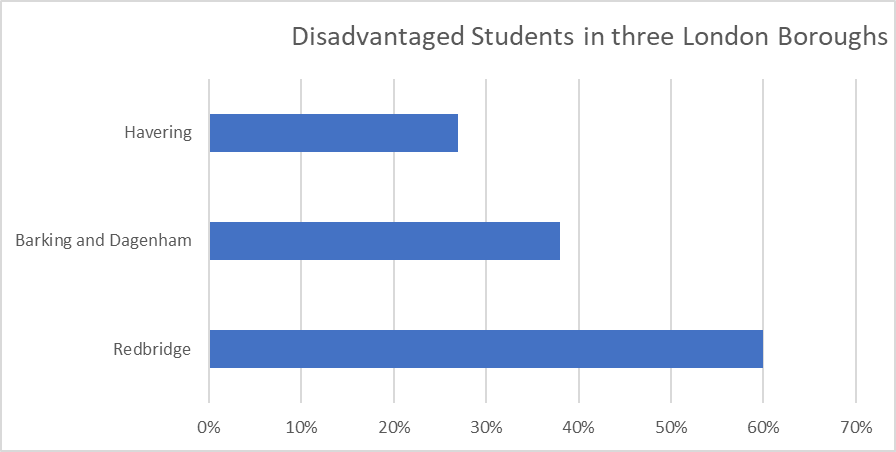
The ‘attainment gap’ is based on failing to achieve Grade 5 GCSE in English and Maths because of poverty. It is used by the government in their analysis of results.2 There are shocking variations between boroughs in their achievement. Students in Redbridge are more than twice as likely to get the Gold Standard as those in Havering.3 (see graph below)

Barking and Dagenham is the fifth most deprived borough in England4 whilst its neighbour Havering is prosperous. Many schools have a successful learning environment for disadvantaged students. Other schools, apparently, expect them to fail by not meeting their needs.

Havering’s 653 Year 11 disadvantaged students in 2023 achieved a ‘Gold Standard’5 pass rate of 27%. Barking and Dagenham’s 939 disadvantaged students achieved a 38% pass rate. Eleven percentage points is a chasm. If Havering’s schools matched Barking and Dagenham’s, the success rate would soar. Put simply, it equates to an additional 68 passes for Havering’s Year 11s in 2023.

All of Havering’s schools are academies who are accountable for these disastrous results. The academies are entirely responsible for educational outcomes.

Notes

1 SN06700.pdf (parliament.uk)

2 Compare the performance of schools and colleges in England – GOV.UK (www.gov.uk) This is an invaluable resource and is relatively straight-forward.

3 Havering’s GCSE Attainment Gap, 2023 – Politics in Havering  See also Havering and Redbridge’s Disadvantaged Secondary Students – Politics in Havering  ‘Gold Standard’ as it is a principal gateway qualification post-16

4 IoD2019_Statistical_Release.pdf (publishing.service.gov.uk) See especially map 2 on p12


Havering’s GCSE Attainment Gap, 2023

GCSE Grade 5 English and Maths is as crucial for disadvantaged students as for all other youngsters. Unfortunately, disadvantaged students do so badly in some schools, it’s as if they’re victims of a conspiracy.1

The Gold Standard for GCSE is ‘Grade 5 English and Maths’. This is the benchmark used to define the attainment gap. It’s ‘Gold’ because it impacts on post-16 opportunities where success is a game changer. Regardless of the excellence of other GCSE results students must have Grade 5 English and Maths to progress to ‘A’ level for example.


St Edwards is the only Havering school with a level playing field for disadvantaged students.

The Human Cost

In 2023, 653 disadvantaged students sat GCSE. The national success result for all students is 45.3%.2 This benchmark means 295 disadvantaged students should have achieved the Gold Standard in Havering. Their actual results are 175 Gold Standard passes (27%). 120 students were denied many post-16 opportunities because their school didn’t level-up the achievement gap by using government funds efficiently.

(If St Edwards is used as the benchmark, Havering’s attainment gap increases to 151 students.)

Government funding for disadvantaged students

Schools with disadvantaged students receive £1,035 per student Pupil Premium (PP) funding. ‘Disadvantaged’ means receiving ‘Free School Meals’ or being ‘Looked After’. The money is paid directly to schools as they’re trusted to use the funds wisely and ‘level-up’ achievement.3 The minimum the government paid Havering’s 18 schools for Year 11s, 2022-3, is £678,249. Most of that funding wasn’t used efficiently as can be seen from the table above.

The Attainment Gap: Marshalls Park and Emerson Park

Both schools achieved 45% ’Gold Standard’ results for students in general but utterly failed disadvantaged students with a ‘success’ rate of 16% and 17% respectively.  

  • Emerson Park don’t publish exam results but state, “Emerson Park Academy is, once again, celebrating an outstanding set of GCSE results.” (my emphasis)
  • Marshalls Park don’t publish their results either. They say, “We believe that we provide an academic education, that is grounded in strong literacy and numeracy….” (my emphasis)3

The government’s PP funding stream for Year 11 disadvantaged students is £46,575 for Marshalls Park and £48,645 for Emerson Park. Neither the government or Year 11 disadvantaged students got ‘value-for-money’. It’s clear PP funding isn’t used to the best effect. Both schools have strategies which need an urgent revisit with external experts.

The Attainment Gap: OFSTED

The attainment gap is not discussed in OFSTED reports nor is the use of Pupil Premium funding.4

Notes

1 The-Forgotten-Third-Interim-Report-March-2019.pdf (ascl.org.uk) This research focuses on Grade 4 and is less than what is used for this discussion. Grade 4 is an entry level qualification and is discounted for ‘A’ level courses.

2 Key stage 4 performance, Academic year 2022/23 – Explore education statistics – GOV.UK (explore-education-statistics.service.gov.uk)

3 Emerson Park Academy – A message from Mr McGuinness regarding GCSE Results This relates to 2022 there is nothing for 2023 even though the data was accessed February 2024. See also Marshalls (marshallspark.org.uk)

4 Marshalls Park 50148108 (ofsted.gov.uk) See also Emerson Park 50193985 (ofsted.gov.uk)


.


Why isn’t there a Standard Format for the publication of GCSE results?

Havering doesn’t have a standard format for publishing GCSE results.1 As a result they’re difficult to interpret. Havering’s schools aren’t alone;

Woodford County High, Redbridge2

No of Year 11 pupils 178
No of GCSE entries 1754
% of levels 9 – 7 (equivalent to A*+ A Grades ) 80%
% of levels 9 32%
% of pupils achieving 5+ levels 9-5 100%
% of pupils achieving 5+A*-C levels 9-5 including English & Maths 99%
% of students attaining English Baccalaureate 97%

There’s little detail – does the school have any weak subject areas? – but what is published is intelligible.

Hornchurch High School3

This school offers time-lapsed results from 2022, even though the 2023 results came out in late August ’23.

Performance Measure
Progress 8 Score -0.42
Attainment 8 Score 45.4
% pupils achieving a grade 5 or above in GCSE English and maths 40
% pupils entering the English Baccalaureate (EBacc) 72
English Baccalaureate Average Points Score 4.22
% of pupils staying in education or employment after KS4 88

Who this set of statistics is for is unclear. Current information can be found on the government website4 – which the school identifies. That website is full of statistical detail, which might not suit everyone.

Abbs Cross Academy5
They offer 2023 results without mentioning subject areas beyond an English and Maths analysis. They offer a link to the government’s website for a league table.6 (They are average.)

Sacred Heart of Mary
Meanwhile Havering’s top performing school,7 shows what should done and provides a template for every school in Havering. Every subject is listed with the outcomes and the number of pupils who sat each examination.

Conclusion

There’s no acceptable explanation why Havering’s schools conceal examination results from parents and taxpayers. Last year this blog wrote about the same issue and ONE school immediately took action. Schools should understand that the publication of results is in their interests. This is especially the case in an era of conspiracy theorists.

Notes

1 How Havering’s Academies Conceal their 2022 GCSE Results – Politics in Havering

2 Woodford County High School For Girls – 2023 Exam Results

3 Hornchurch High School » EXAMINATION PERFORMANCE, 2021-22

4 Secondary – Hornchurch High School – Compare school and college performance data in England – GOV.UK (compare-school-performance.service.gov.uk)

5 Achievement And Performance – Abbs Cross Academy The school’s analysis of English and Maths is very technical and beyond most non-educator’s understanding. Effectively it’s meaningless for most parents.

6 All schools and colleges in Havering – Compare school and college performance data in England – GOV.UK (compare-school-performance.service.gov.uk)

7 GCSE-RESULTS-SUMMER-2023-v3.pdf (realsmart.co.uk)

Havering’s Academies: School Uniforms and the Cost-of-Living Crisis

The statutory guidance was published in November 2021 and advises, in order to keep the cost of uniforms down, for branded items to be kept to a minimum and for high street items to be allowed. It also states that second-hand uniform must be available, providing cost-effective and sustainable options.1 (my emphasis)

Abbs Cross, Hornchurch: “All items marked with a * must be purchased from the school supplier.” These include: blazer; tie; school jumper; rugby shirt and PE socks. The minimum cost is £83 and the maximum cost is £96.2

These additional items are compulsory.

  • Black trousers or skirt and socks/tights plus a white shirt
  • Polished black shoes – black laces, black stitching, black sole and heel3
  • Appropriate jacket or coat
  • PE polo top; PE joggers; PE shorts plus PE fleece jacket. All with school logo
  • Swim shorts/suit plus swim cap

Logos increase costs and Abbs Cross breaches government guidance.

Sacred Heart of Mary, Upminster: Dark navy blue pleated skirt or navy trousers. These items are available only from the School Shop. Other items can be bought elsewhere. Navy leggings with School Badge Blue fitted Polo Shirt with School Badge  Netball Skirt with School Badge Gym Shorts – All have to be bought from the school shop.” (my emphasis)

They follow government guidance quite well.

It’s cheaper attending Sacred Heart because fewer items are sold non-competitively. Helpfully, fewer items require logos.


Marshalls Park, Romford: “
Uniform is not fashion-orientated and, should individual items of clothing be deemed inappropriate, we will contact parents/carers.”5 Only the school badge and tie are purchased from their Resources department. Their uniform policy is prescriptive but good efforts to reduce the cost burden are in place.

This academy fully complies with government guidance.


Conclusion

School uniform is a tax on learning. Children must attend school in uniform. The government’s attempt to mitigate costs aren’t universally obeyed. Worse, control-freakery6 adds to the costs for hard-working families. Parents/carers should make representations to the governors about this scandal.


Addendum: Government guidance on dress codes

Consult widely on a proposed school dress code policy (or any changes to a policy) with pupils, parents/carers, school staff and governors including making use of school assemblies and school councils to achieve respect for diversity and an ethos of inclusion. Include school staff in the development of the policy in order to achieve consistency across the school in applying the dress code.

Ensure the items of clothing in the dress code being proposed are affordable for all who wish to attend the school.1


Notes

1 School uniform | NEU

2 Abbs Cross Academy – School Uniform Direct Loxford Group includes Abbs Cross and four secondary academies. Having a sole supplier is worth an estimated £500,000 in ‘tethered’ i.e. non-competitive sales.

3 For a discussion of Havering’s academies control freakery on shoes see Havering’s Academies: School Shoes and Shoe Laces – Politics in Havering

4 Uniform | SACRED HEART OF MARY This academy is last in the list of Havering’s academies and wasn’t chosen to make a  point.

5 Uniform-Policy-May.pdf (marshallspark.org.uk)

6 The use of logos on clothing is a classic example; hyper specific descriptions of shoes are another.

Havering’s Academies and Community Governors

Havering’s secondary academies’ policies on school uniform and personal appearance are virtually identical. It’s as if they collaborate in an institutional Group Think. Their decision-making is embedded in collective unchallenged beliefs. No academy has councillors, parents or teachers as governors. School uniform and personal appearance policies don’t enhance educational achievement. This emphasises that the academies’ approach to micro-managing students is bizarre.

In October 2022 this blog discussed coloured shoelaces,1 which are uniformly banned. Wearing coloured shoelaces can result in students being excluded from lessons. Hairstyle conformity is also an important ‘appearance’ policy.2 Schools seem unaware some ‘extreme’ hairstyles are legal and can’t be banned because of their racial context.

Race-based hair discrimination has been illegal in the UK since the Equalities Act became law in 2010 but the Halo Collective says it is still a really big problem.

A recent survey said 46% of parents say their children’s school uniform policy penalises afro-hair.3

In 2020 a Hackney student took her school to court because of the enforcement of a hairstyle policy. She won her case.

A pupil who was repeatedly sent home from school because of her afro hair wants to make sure it doesn’t happen to any other UK schoolchild.

Ruby Williams received £8,500 in an out-of-court settlement after her family took legal action against The Urswick School in east London .4

Excluding the community alienates the principal stakeholders. It’s difficult to believe legal Afro hairstyles are permitted in Havering’s academies for example.2 Community involvement challenges extremist Group Think policies, which have no educational purpose. Academies are in an intellectual cul de sac in relation to school uniform and appearance codes.

Notes

1 Havering’s Academies: School Shoes and Shoe Laces – Politics in Havering

2 This is typical: “It will be for the Headteacher to decide if a hairstyle is “extreme”. It is difficult to definitively set out in advance what will be regarded as an “extreme hairstyle” as styles vary regularly according to fashion. Students are therefore expected to speak to their Head of Year before they alter their hairstyle or dye their hair to obtain confirmation that the proposed new hairstyle will comply with this policy.” Year-7_11_September-2021.pdf (cooperscoborn.org.uk) This can be summarised as, ‘If we don’t like it, you can’t have it.’ Compare Uniform-Expectations-September-2021.pdf (bowerpark.co.uk) And FBA-uniform-policy-June-2020-r-1.pdf (fbaok.co.uk) Frances Bardsley The other 15 Havering academies cluster in the same territory.

3 Halo Code: What is it and how does it protect afro hair? – CBBC Newsround 10th December 2020
4 Ruby Williams: No child with afro hair should suffer like me – BBC News 10th February 2020