Havering’s Council Meeting 8th July, 2020*

The show began as satire. The first five minutes were spent discovering that the priest who’d led prayers was on mute. A great opening scene for, ‘Bumbling Councillors Meet Zoom.’ The mute gag was terrific and occurred repeatedly. Each time it was used everyone seemed genuinely surprised, which added to the joy of it. ‘Are we on mute?’ a truly great catch phrase.

Casting is all important for a show. This show needed a cartoon villain, a well-meaning elderly gent, a pompous young big-head, a council officer who wanted to be somewhere else and a strong group of walk-on parts. Casting did a magnificent job.

The mute gag degenerated into farce. Spending 25 minutes discussing, ‘How to vote!’ tested the patience of the audience. Severe editing was needed. Satire transformed into farce. Those who remained in the audience and loved farce, sensed magic in the air and hung on. They were richly rewarded.

A well choreographed conflict between, ‘Cartoon Villain’ and ‘Pompous Young Big-head’ didn’t disappoint. There’s nothing like teasing abuse to provoke a Cartoon Villain. Damian White did it with flair and a well practised smirk. Now and then he stoked the flames when it looked as if the gag was flagging.

And the winner was… Damian White! Once again he evaded any accountability.

* For the webcast see https://www.bing.com/search?q=havering+council+meeting+webcast&form=ANSPH1&refig=0343091694f646b287e301508ec75146&sp=1&qs=HS&pq=ha&sk=PRES1&sc=8-2&cvid=0343091694f646b287e301508ec75146

1) The first five minutes are the opening gag, which is sort of fun. Then there is 20 minutes of ‘How do we vote?’ which is fun for those who like train-crash humour.

2) If you fast forward to 1 hour 6 minutes the next 20 minutes reveal why Havering is more-or-less dead politically speaking.

Reopening Havering’s Schools: Governors Will Decide

Good government requires ministers and civil servants who pay meticulous attention to detail. Reopening Havering’s schools needs careful judgement not prejudiced, hand-wringing bluster. They were shut because of the government’s public health strategy in March, 2020. Public health is a government responsibility but health and safety in schools is devolved to school governors and Academy Trust management teams.

The Covid-19 pandemic hit Britain in February, 2020, becoming severe during March when the government declared a public health emergency. Public health legislation is a sledgehammer closing every school regardless of local conditions.

It’s seductively simple closing schools but reopening them is complex. Schools aren’t managed by the government. Havering’s schools will open when their governors are satisfied that the health and safety of staff and pupils is guaranteed. Health and safety is a responsibility of governors or the Academy Trusts. Government can advise but can’t instruct. The indicated date of June 1st has been challenged across the country because of local circumstances.

Havering’s schools will reopen when governors are satisfied it’s safe to do so for staff and children. The arrangements will reflect the geography of their school buildings. Local knowledge is crucial here and will be used to keep Havering’s staff and children safe.

Sources

For school closures see https://www.gov.uk/government/news/schools-colleges-and-early-years-settings-to-close

For the responsibility of school governors see https://schoolgovernors.thekeysupport.com/finance-and-premises/health-and-safety/

For the reopening of Havering’s schools see https://www.theguardian.com/politics/2020/may/10/boris-johnson-coronavirus-lockdown-shops-schools-june-reopening

Alan Gorsuch: Love and Fear 1939-40

War broke out to the sound of air raid sirens. Alan’s parents believed war meant bombing and gas attacks. When a safe haven in Oxfordshire was offered for Alan they were thankful. Alan’s brother, Brian, was evacuated with his school elsewhere, so their family was broken up. Unselfishly they were certain it was the right thing to do putting him above their emotional needs.

Alan was five in 1939 and hadn’t been out of London. Alan’s interminable journey involved crossing London and two hours on a coach to Headington. His new home was Downside Road, on an estate built for Oxford’s motor industry just like Dagenham.

Alan wasn’t welcomed in his new school. Oxford was insular and he was ‘alien’. Alan’s first experience of school included consistent bullying. Although ‘Auntie Hilda’ was lovely he had severe challenges each day, which he had to cope with. Being five he wasn’t always successful especially during the night. Almost unimaginably Alan was completely cut-off from his family. There was no phone and being five he couldn’t communicate his feelings to his mother by letter.

Alan returned to Dagenham in 1940. The eight month ‘Phony War’ was ending but they didn’t know that then. Unsurprisingly Alan’s parents took the view they’d been suffering unnecessarily. He returned as the Blitz began. His mum kept him in the house till the war ended. Love conquered fear.

Once home in Becontree Avenue Alan thrived. He went to Stevens Road school. Like most people in Dagenham he spent considerable periods of time in Anderson shelters between 1940 and 1943 and, after the war, in 1946, he entered Ilford County High School.

Source
Alan and I have sat next to each other at Dagenham & Redbridge FC for quite a few years. He is absolutely impressive and I’m delighted to have written this biographical fragment, which has been done with his help.
Other Sources
For memories of Headington see http://www.headington.org.uk/history/reminiscences/index.htm
For a general history http://www.headington.org.uk/history/timeline_briefhistory/briefhistory.htm
For the phony war September 1939-March 1940 see https://www.britannica.com/event/Phony-War
For Chadwell Heath’s history see https://www.francisfrith.com/chadwell-heath/memories

Damian White and the Covid-19 Challenge

The government is sending mixed messages but they’re at least sending a message. Matt Hancock knows he’s mouthing words, whilst Dominic Raab has the rigid steely eyed look of someone mainlining on class A drugs, ready for an ordeal. Here in Havering Damian is bunkered down. It’s difficult to know why. All he has to answer are simple technical questions and here are a few.

Havering’s finances have taken a tremendous hit: but how big a hit? Damian’s infamous 2019 car parking charge increases were ‘essential’ and now that’s all disappeared. How much per month has gone over the Covid-19 cliff face? What’s the nature of the contract with those enforcing car parking? Are there break-clauses and if there aren’t, has the workforce been furloughed? Sunak, the chancellor, has made large with taxpayers’ money, so why can’t we have some to fill gaps in our finances?*

Obviously the council finances need to be strengthened after Covid-19. Is the Freedom Pass part of Damian’s calculations? It costs £7 million and would repair some damage. If that’s too toxic for the Harold Wood 3, does Damian have any viable suggestions?

Damian is thin skinned and believes any criticism is hostile, but he’s going to have to mature. Covid-19’s a unique situation and he needs to carry the borough with him. Sunak’s solution is virtually communist. He’s currently employing 50%+ of the British population, albeit for a limited period. Damian should listen to constructive criticism. Some of us have the well being of Havering at heart.

* The token gesture he made to the council is pitiful in relation to the savaging that has been handed out during the years of austerity.

Nine International Airmen Buried in Hornchurch


Russell Norris Langley, Canadian and A Spitfire pilot from Czechoslovakia

Hornchurch airfield was crucial in the defences of London during the Second World War. Many airmen sacrificed their lives and these foreign volunteers are buried in the Commonwealth War Graves section of the Hornchurch cemetery. They fought and died fighting for freedom with the RAF.

After Czechoslovakia was invaded by the Nazis in 1939, many Czech pilots escaped with their aircraft to France. After France fell in spring 1940, they came to Britain and joined the RAF Volunteer Reserve. There were about 88 airmen in the RAF, two of whom are buried in the Hornchurch Cemetery War Graves section.

Blazej Konvalina was aged 23 when he died in January, 1942 in a flying accident at Purfleet.
Josef Valenta died during take-off at Hornchurch in January, 1942.

The Czechs wanted to continue the war against Hitler but New Zealanders fought because Britain was the Mother Country. They felt British and so our war was their war. New Zealand contributed seven squadrons to the RAF as well as 135 airmen. They have three men in Hornchurch cemetery.

Samuel David Earwalker was aged 26. His Spitfire plunged to the ground at Chelmsford in January, 1943.
Erl Joseph Kean was aged 33. He was shot down near Maidstone in April, 1941 by a Bf109 whilst on patrol.
Francis MacKay Laing was aged 29. After combat, he was returning to base and crashed near Hawkinge in July, 1941.

Like the New Zealanders, Canada was also motivated by being part of the Empire. They became the fourth largest air force in the war. Canadians suffered tremendous losses in bombing raids over Germany and they contributed to every aspect of the air campaign. There is one Canadian buried in Hornchurch cemetery.

Russell Norris Langley was aged 24. He died in a crash but I couldn’t find out where, though the date is February, 1942.

The sole South African buried in Hornchurch had lived in England for an extended period of time. He was a university student of mining, which is appropriate as he came from the Transvaal, the South African centre of gold mining. He was a member of what Churchill called The Few. Volunteers from RAF Hornchurch tend the graves of The Few.
Claude Waller Goldsmith was aged 23. He was shot down by a German Me 109 over Maidstone in October, 1940.

Another man with a connexion to Britain, even though having a different nationality, was an Argentinian. He had British parents and was born in Rosario.

Thomas Wilton Smith was aged 24. He came to Britain in 1940 and died of his injuries in Chelmsford in December, 1943.

The American, Raimund Sanders Draper, joined the RAF via Canada. It isn’t illegal for Americans to fight for foreign countries as long as they don’t fight against the USA, but it shows tremendous commitment.

Raimund Sanders Draper was aged 29. He died when his Spitfire had catastrophic engine failure on take-off. He saved the lives of children at Suttons Senior school,
“At 10.45 am an aircraft crashed on the playing field, the main parts being ricocheted onto the drive, fragments breaking a total of 9 windows in three classrooms. Splinters from the ‘plane scored the wall and injured the playing field and shrubbery. Richard Burton received a cut on the leg from flying glass needing medical attention and five boys were treated from primary shock. The boy with the injured leg was conveyed to his home by ambulance, under Dr. Heath’s orders. School was evacuated to shelter for 15 minutes owing to probability of danger from fire and exploding ammunition. By 11.15 am the school had resumed normal work.”*
* https://en.wikipedia.org/wiki/Raimund_Sanders_Draper

Sources
For foreign airmen in the RAF see https://en.wikipedia.org/wiki/Non-British_personnel_in_the_RAF_during_the_Battle_of_Britain
For the Royal Canadian Air Force see https://www.warmuseum.ca/cwm/exhibitions/chrono/1931rcaf_e.html
For the Royal New Zealand Air Force see http://www.airforce.mil.nz/about-us/who-we-are/history/wwii.htm
For a very interesting review of the Czech Air Force in WW2 see https://fcafa.com/2014/09/18/a-short-history-of-the-czechoslovak-air-force-in-ww2-and-the-post-war-period/
http://www.historyofwar.org/air/units/RAF/122_wwII.html

Sources for local history
For a very good overview see https://commons.wikimedia.org/wiki/Category:RAF_Hornchurch
and http://www.beyondthepoint.co.uk/property/raf-hornchurch/#1511813767070-0eecaf5b-59db
For the inter-war era see https://www.rafhornchurch.com/history/inter-war-years/
and for the conservation status of the area see https://www.havering.gov.uk/download/downloads/id/1970/lbhlp47_raf_hornchurch_conservation_area_appraisal.pdf pp8-9
For photographs see https://www.google.co.uk/search?q=raf+hornchurch+photos&sa=X&biw=1460&bih=761&sxsrf=ALeKk000RTv9AmmxjMcUJwRGdMPmJqBmuQ:1586451685367&tbm=isch&source=iu&ictx=1&fir=Tywuxcbje7vdsM%253A%252CPpSGvSfmqAI2zM%252C_&vet=1&usg=AI4_-kRLF1tKIM4sickAQk945tMdVramwA&ved=2ahUKEwjVlKOJ6dvoAhXKasAKHRJ2BMoQ9QEwBHoECAoQHw#imgrc=Tywuxcbje7vdsM:
For a brilliant interactive map see http://www.rafhornchurch.thehumanjourney.net/map.htm
After the war the site was used for gravel winning see https://www.rafhornchurch.com/history/life-after-the-airfield/

Special thanks to Tony Philpot, chair of HAHT for his kind assistance
.

Sanders School, Hornchurch: renamed in an act of disrespect

Introduction

Raimund Sanders Draper was an American volunteer who flew Spitfires in the Second World War and on the 24th March, 1943 he crashed landed. His plane developed catastrophic engine failure immediately after take-off. In his direct flight path were two schools with hundreds of children in them. He made an instantaneous decision to sacrifice his life and save theirs. In 1973, Suttons Secondary School was renamed Sanders Draper School to honour his memory. Forty years later the school was renamed Sanders school. This was deeply resented in the community as an act of disrespect.

Discussion
Sanders Draper was an under-performing school in 2013. Headteacher, John McEachern, decided that renaming the school would improve achievement. He believed the name ‘Sanders Draper’ was synonymous with failure. It’s difficult to understand his reasoning. To lift achievement by a name change seems unlikely at best. It might work for soap powder but educational achievement is complex and multi-faceted. Yet he did believe it and he persuaded the governors to change the name despite voracious opposition. The outcome?

John McEachern’s leadership led to a reduction of achievement based on expectations from primary school evidence. (see Addendum: 1 and 2) The adjacent Suttons primary school is rated ‘good’ by OFSTED, which further highlights his disappointing leadership.

John McEachern and the governors had a tragic lack of self-awareness. They were blind to their failure, which caused mediocre achievement. Instead, they engineered a puerile quick fix and a pointless provocation to a community proud of their history. They were replaced in 2017.

Conclusion
Sanders school is now part of SFAET, an academy trust.

Addendum: OFSTED reports
(1) “Students join the school with attainment which is broadly average. The group of students who took their examinations in 2013 unusually had above average attainment on entry. Although the proportion achieving five or more GCSEs at grades A* to C including English and mathematics improved and was above the national average, the progress made by these students was less than average.” 2014 OFSTED Report p6

(2) “Pupils attained standards at least in line with the overall national averages in GCSE examinations. However, variations between groups of pupils, including the most able, the most able disadvantaged and disadvantaged boys, and between subjects, meant that overall improvements in outcomes were modest.”* 2017 OFSTED Report p6
* ‘modest’ means non-existent.
Sources
For the name change see https://www.romfordrecorder.co.uk/news/education/anger-at-disrespectful-name-change-of-hornchurch-school-named-after-hero-pilot-sanders-draper-1-3545992 See also https://www.dailymail.co.uk/news/article-2603118/Anger-school-named-heroic-Spitfire-pilot-sacrificed-save-hundreds-pupils-changes-name.html
For the 2013 OFSTED Report see https://files.ofsted.gov.uk/v1/file/2193029
For the 2014 OFSTED Report see https://files.ofsted.gov.uk/v1/file/2430137 especially p6
For the 2017 OFSTED Report see https://files.ofsted.gov.uk/v1/file/2676415 especially p6
For the current government performance analysis see https://www.compare-school-performance.service.gov.uk/school/146309/sanders-school/secondary
For the first OFSTED Report (2018) after the resignation of John McEachern see https://files.ofsted.gov.uk/v1/file/2772447

Rene Wyatt: Life Goes On – 1940-45

Rene’s house, 204 Lancaster Drive, was inside the perimeter fence of RAF Hornchurch during the war. Unlike many of her friends she wasn’t evacuated, ‘We’re a family and we live or die together,’ was her father’s uncompromising attitude. Her memories are vivid, but not what you’d expect. Rene ‘got on with life’. War was for adults not children.

Rene’s father rose to the challenge of war. Despite rationing they always ate well because he turned their garden into a mini-farm. It had a rabbit hutch, chicken coop and a sunken galvanised bath for ducks. These weren’t pets. They were food. There were no secrets about where food came from in the Wyatt household and no room for squeamish hesitation.

Her father’s allotment provided vegetables. Rene says that, ‘We ate better then than nowadays’. Fruit came from the Bramley apple tree and there were gooseberries, blackberries, plums, rhubarb and eating apples. They knew exactly what they were eating, which was always seasonal.

Rene moved from Ayloffs to Benhurst primary school because it was dangerously close to the airfield. After Benhurst, she went to Suttons Senior School, which was divided into boys’ and girls’ sections. This mattered on the 24th March, 1943 when Raimund Sanders Draper saved hundreds of lives by deliberately sacrificing his life. His crash landing plane slid to a halt on the boys’ side with just one child slightly injured. If he hadn’t sacrificed himself, that side of the school would have been devastated. Rene was on the other side of the building and wasn’t directly affected though it was a great shock for her and everyone else.

Rene wasn’t oblivious to the war. During the Battle of Britain, ‘The Few’ flew out of Hornchurch day after day. Ack-ack guns fired continuously and she spent long periods in the Anderson shelter. Her father buried it in the garden covering it with soil to make it as bomb proof as possible. It was very damp, very dangerous and uncomfortable. Rene remembers one week-end going into the shelter on a Friday and being there until Sunday night. Overnights were normal.

Going to school, meeting friends or going to the shops meant showing her pass to the sentry at the gate. That pass, her gas mask and the ration card were crucial to her day-to-day life. Rene’s family came through the war unscathed. She doesn’t dwell on the war or her experiences but they offer a unique insight away from all the well known aspects. She saw ‘The Few’ daily but got on with being a child in exceptional circumstances.

Source

Rene, my neighbour and friend, talked to me many times over our fence. I’ve also had assistance from her daughter Jackie and grandchildren.

If you are interested I’ve put together a few sources that add to Rene’s story

For a very good overview see https://commons.wikimedia.org/wiki/Category:RAF_Hornchurch
and http://www.beyondthepoint.co.uk/property/raf-hornchurch/#1511813767070-0eecaf5b-59db
For the inter-war era see https://www.rafhornchurch.com/history/inter-war-years/
and for the conservation status of the area see https://www.havering.gov.uk/download/downloads/id/1970/lbhlp47_raf_hornchurch_conservation_area_appraisal.pdf pp8-9
For photographs see https://www.google.co.uk/search?q=raf+hornchurch+photos&sa=X&biw=1460&bih=761&sxsrf=ALeKk000RTv9AmmxjMcUJwRGdMPmJqBmuQ:1586451685367&tbm=isch&source=iu&ictx=1&fir=Tywuxcbje7vdsM%253A%252CPpSGvSfmqAI2zM%252C_&vet=1&usg=AI4_-kRLF1tKIM4sickAQk945tMdVramwA&ved=2ahUKEwjVlKOJ6dvoAhXKasAKHRJ2BMoQ9QEwBHoECAoQHw#imgrc=Tywuxcbje7vdsM:
For a brilliant interactive map see http://www.rafhornchurch.thehumanjourney.net/map.htm
After the war the site was used for gravel winning see https://www.rafhornchurch.com/history/life-after-the-airfield/

Neave Crescent, Harold Hill, Romford

People don’t think about street names: Farringdon Avenue, Gascoyne Close and Neave Crescent are much of a muchness. That is unless you know Neave Crescent is named after slave-owners and slave traders. They owned much of Harold Hill. Their historic status meant a school, now closed, was named after them as well as Neave Crescent. So what?

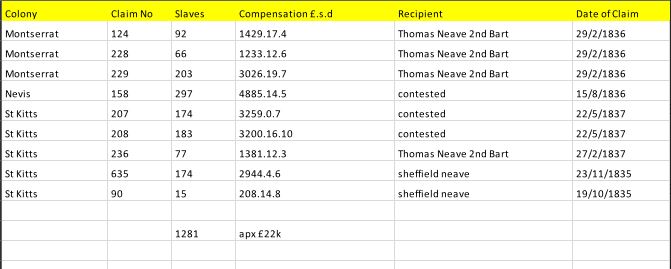
The Neave family became rich from slavery. In 1833 they owned 1200+ slaves which were bought from them, after abolition, by the government for about £22,000.* 187 years later why does it matter? On one level it doesn’t matter at all. No-one living in Neave Crescent endorses slavery.

Yet it does matter. In the 1930s, in Germany, many streets were named after Hitler: they’ve all gone. But surely it’s over-egging the pudding equating a slave-owner with Hitler? It is but they’re in the same territory. Odious, brutal, inhuman behaviour shouldn’t be celebrated in any shape or form.

Neave Crescent celebrates a slave-owner. Slavery is a blot on British history. It isn’t rewriting history to delete this street name. It’s an important statement of British values. Perhaps it should be renamed Wilberforce Crescent?

* A servant in their house, Dagnam Park, would have been paid about £10 a year in 1833

The Neave Family Slaves, 1833

Slavery was abolished in the British Empire in 1833. Abolition depended on the British government compensating slave-owners for their ‘property’. The government budgeted £20 million. This breath-taking sum recognised the large numbers of British people directly implicated in slavery through finance, families like the Neaves of Romford.

Compensation claims submitted by the Neave family to the Slavery Compensation Commission included contested claims because slaves were also a ‘financial instrument’ underpinning annuities and mortgages. For example, slave-ownership was normal for wealthy families like the Neaves.

neave slave figures

The government felt it wasn’t worth protecting slavery in the Caribbean for families like the Neaves. The expense of keeping the Royal Navy and army in readiness was a drain on the naval budget, a situation that they were sure would worsen over time. Therefore the British slave-owning class was bought off.
The abolition of slavery in 1833 wasn’t an act of generosity. It was the pragmatic recognition of the odiousness of slavery whilst ‘squaring the circle’ about the importance of slavery to the finances of many British people. That was the genius of the 1833 Act. The government bailed-out the slave-owners, avoided costly military campaigns in the Caribbean and took the high moral ground.
Addendum: from the parliamentary debate 1833

“They were beings of the same flesh, bone, and muscle as ourselves—they were imbued with the same immortal spirit—they were rendered heirs, by the same blood, to the same glorious eternity as we—and was it to become in these days a question and a doubt whether they were entitled to the first birthright of mankind—freedom? He would put a case: suppose that the hon. member for Lancaster who had so ably and eloquently defended the cause of the West Indians, was taken prisoner on his way out to the West Indies, by a corsair, and sold for a slave, should he remonstrate and say he had primitive as well as rational rights which interdicted his being considered as a slave, he would doubtless be told there was a law in that country making him a slave, and thirty-nine lashes would be his least reward for talking reason to his master.” Mr O’Connell Col. 316 HC Deb 3rd June 1833 Ministerial Plan for the Abolition of Slavery 1833

Sources

This £20 million is subject to lurid inflation calculations which range from £1 billion (http://discoveringbristol.org.uk) to David Olusoga’s £16 billion (Guardian 12th July 2015). These calculations serve little purpose and are ‘tabloid’ headline grabbers.

UCL Legacies of British Slave-ownership A superb on-line database

Admiral Fleming HC Debate 3rd June 1833 c. 326 see also http://www.abdn.ac.uk North East Story: Scotland, Africa and Slavery in the Caribbean

Parliamentary Papers 1836
For an excellent site which also deals with the Neave family see http://www.friendsofdagnampark.org.uk/

Havering’s Multitude of Committees: a Recipe for Poor Governance?

Havering council is awash with committees. There are nineteen altogether, some of which have no other function than providing allowances. What’s needed is a spring clean. This would create savings and make Havering a better governed borough.

The Highways Advisory Committee has been scheduled for 22 meetings since 3rd July 2018. Nine have been cancelled. Brian Eagling, the chair, is a workaholic compared to Michael Deon Burton and Ciaran White. They have chaired the Joint Venture Working Party. Since 22 October, 2018 it’s proceeded at a leisurely pace with three further meetings up to 14th January, 2020. The pay £7,650. Interestingly in Appendix A they state the Working Party’s ‘Meetings will be held at approximately two month intervals’.
Michael and Ciaran are Damian’s cronies.

Ciaran receives more than £2500 an hour. Yet another White, Michael, is chair of the Governance Committee. His committee has had 22 meetings since May 2018: six have been cancelled. He receives £7,650 but as he’s a fellow member for Damian’s ward that’s to be expected.

A clear out of these committees, and others, is long overdue. The fact is allowances look like quasi-bribery (though not with Bob Perry) isn’t the only story. Councillors are wasting their time. Vital issues are buried and the topic opportunity is moribund, notwithstanding the fact that it’s a necessary part of the councillors’ job to enhance their communities.

Source

Click to access Appendix%20-%20JV%20WP%20Appendix%20A.pdf