Hornchurch Country Park: Squadrons Approach to Berwick Ponds

There are number of walks beginning in the Country Park’s spacious car park. The easiest is walking in a more-or-less a straight line down to Albyn’s Farm pond and returning for a cup of tea at the lovely cafe. The walk has a good surface for its entire length so ordinary shoes are OK. There are views about half way along from the top of a steepish slope. This is wonderful if you have a child who wants to run and suddenly realises it’s steeper than it looks.

Both walks are about two miles.

The next one is with the café to the left. Keep going for about a quarter of a mile and turn left. In front of you is a Bailey Bridge. This is a relic of the Second World War. It was originally used by the army in Europe after D-Day.

A Bailey Bridge in use in 1944 in France

After the bridge walk about 100 yards. There’s a signpost, which is easy to ignore as it has graffiti on it, but go to the right. You are leaving the gravel path and the surface is unmade. Walk for about 300 yards and there is another signpost. Take the route to Berwick Ponds. Again, the path is unmade. If there has been a lot of rain it will be muddy!

The ponds are serene and will reward for your efforts. The café is a great place to reward yourself after your exertions.
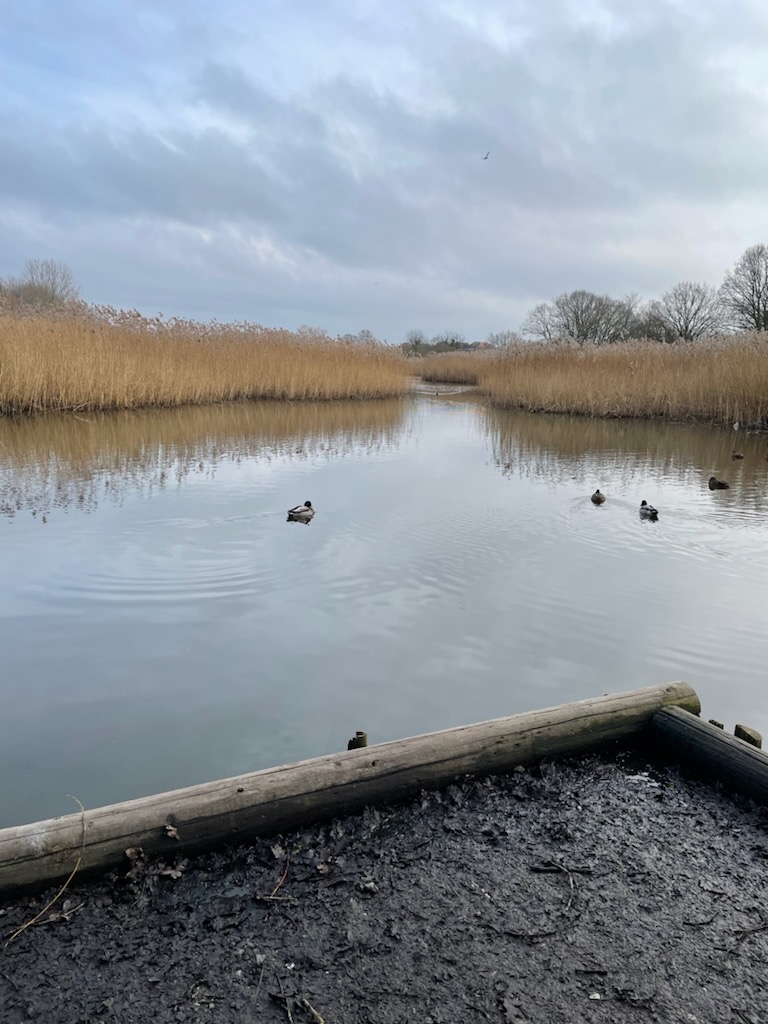
photograph Graham Carr Taken in late January 2024

R. J. Mitchell Primary School: Celebrating Local History

Introduction

R. J. Mitchell didn’t have a direct personal connexion with Hornchurch but in an imaginative gesture his genius is acknowledged by the school named after him. The incredibly courageous RAF pilots who flew out of Hornchurch flew in Supermarine Spitfires, which Mitchell designed. The Spitfire was so advanced and capable as a fighter plane it made victory over the Luftwaffe possible.Mitchell’s Spitfire designs were a crucial contribution to victory by ‘The Few’.Hornchurch is indelibly identified with the battle of Britain, the Spitfire and R. J. Mitchell.

Discussion

The school concludes their brief history of the period by saying,

We do not seek to glorify war, but to remember the sacrifice of brave people in extraordinary circumstances.”

The school reflects the community by honouring the RAF ‘aces’ of the Battle of Britain. This bonds the school with their community. Many of the school’s students come from streets named after fighter ‘aces’ in the immediate area. The school is located in a place which memorialises those fateful years.

Each passing year pushes those existential days further into the mists of history. So does it matter?

History does matter as it gives a sense of place and identity. The rich heritage that is celebrated by R. J. Mitchell School isn’t jingoistic. It’s measured, respectful and is to be applauded.

Sources

For a quick biography see https://en.wikipedia.org/wiki/R._J._Mitchell

For the excellent R J Mitchell School’s celebration of the history of the community see http://www.rjmitchellprimaryschool.com/havering/primary/rjmitchell/site/pages/welcome/historyofourschool

For R J Mitchell School in 2013 see https://www.teachprimary.com/learning_resources/view/outstanding-schools-rj-mitchell-primary